 Stack Overflow
 LinkedIn
 GitHub
If you test an API, you probably know this flow: log in, create a cart, add an item, check out. Each step needs something from the step before it, like a token or an id. hurl-orchestra is a small tool that lets you write each of those steps as a small text file and then runs them in the right order for you. When a step breaks, it tells you which one, and it keeps running everything that does not depend on it.
Its first release on PyPI was 0.4.1. The examples below use the current version, 0.11.0, so you can copy them and run them as they are.
Why I built it
Hurl is a great tool. You write an HTTP request and its assertions in plain text, and it runs them. The trouble starts when a suite outgrows one file. You split the tests, and then you need something to call Hurl in the right order and to carry values like a login token from one file to the next. Usually that “something” ends up being a shell script, and that script only gets bigger.
I wanted to declare the order instead of scripting it. So each file now says what it needs, and the tool works out the rest.
How it looks
A Hurl file gets a small header between two --- lines (this header is called frontmatter, and
it is plain YAML). Here is a login step:
---
id: auth
outputs: [token]
---
POST {{base_url}}/login
{
  "user": "ada",
  "password": "{{password}}"
}
HTTP 200
[Captures]
token: jsonpath "$.token"
A capture is a value Hurl pulls out of a response, here the token from the JSON body. The
outputs list says which captures this step shares with others. Now a step that needs it:
---
id: profile
deps: [auth]
---
GET {{base_url}}/profile
Authorization: Bearer {{auth_token}}
HTTP 200
[Asserts]
jsonpath "$.user" == "ada"
deps: [auth] means “run auth first”. The token arrives as auth_token: the name of the
producer, an underscore, then the output name. I did it this way so that two steps can both capture
a token without stepping on each other.
Running it is two commands:
pip install hurl-orchestra
hurl-orchestra ./tests
Variables file: tests/.env
SUCCESS: auth [captured: token]
SUCCESS: profile [injected: auth_token]
Report saved to tests/report.zipA .env file holds global values like base_url, and every Hurl call gets it. It can sit next
to the tests, or anywhere else with --env-file, for example at the root of your project. The run ends with exit code 0 when everything passes and 1 when something fails, so it
fits any CI.
The graph, in plain words
Behind the scenes, the files form a DAG, a directed acyclic graph. That is a fancy name for a set of steps connected by arrows (“this needs that”) where the arrows never loop back. From it, hurl-orchestra builds waves: a wave is every step whose dependencies are already done. Steps in the same wave run at the same time; the next wave starts when the current one finishes.
You can see the plan without sending a single request:
hurl-orchestra --dry-run tests/checkout.hurlResolved dependencies: add_item, auth, create_cart
Plan: 4 node(s)
wave 1: auth
wave 2: create_cart
wave 3: add_item
wave 4: checkoutNotice that I only asked for checkout.hurl, and it pulled in what checkout needs. The whole graph
is also validated before the first request: an unknown dependency, a cycle or a field with the
wrong type stops the run with a one-line error, so a broken graph never runs half a suite.
A failure stops only its branch
This is the part I like the most. When a step fails, only the steps that depend on it are skipped. Everything else keeps going, so one run shows you every broken flow, not only the first one.
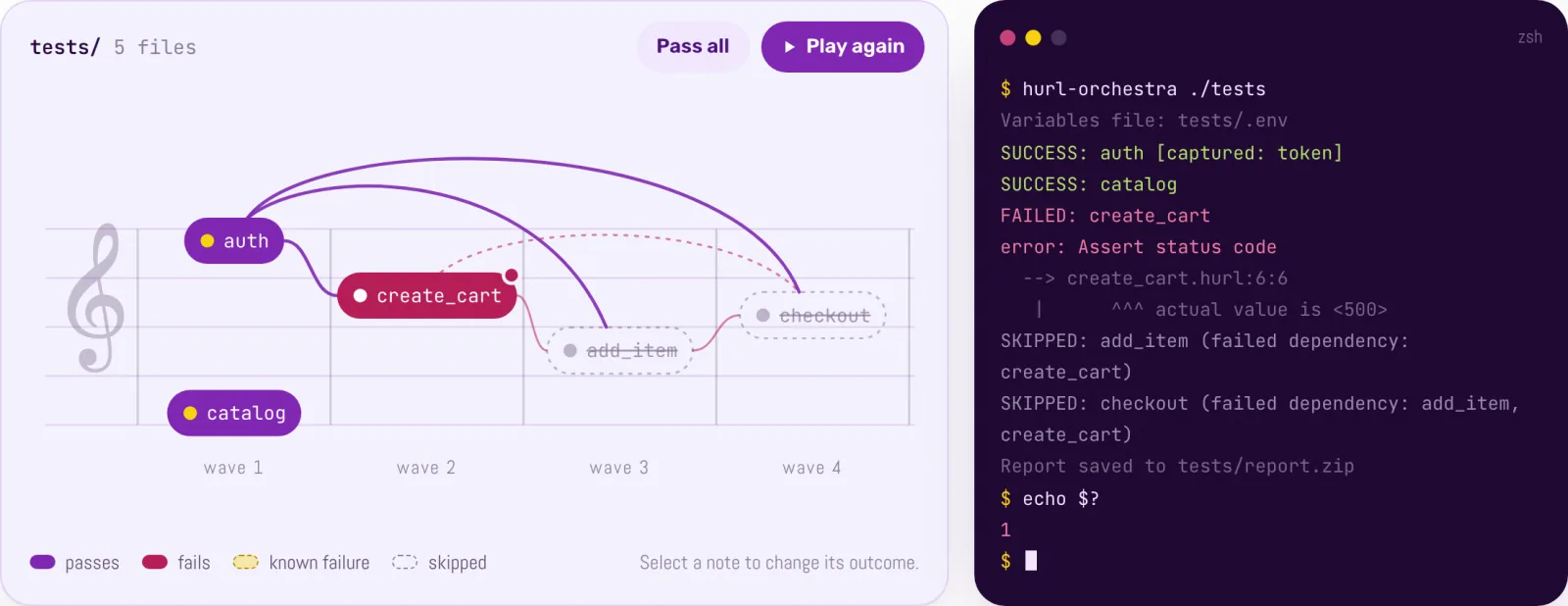
In the picture, create_cart fails, so add_item and checkout are skipped, while catalog,
which does not need a cart, still passes. You can play with this on the
docs home page: pick a step, make it
fail and watch the run.
Why “AI first”
I want to be clear here: there is no model inside hurl-orchestra, and nothing to configure. “AI first” means the files, the commands and the results are easy for a coding agent (Claude Code, Codex and friends) to write, check and read:
- The tests are plain-text Hurl files with a few frontmatter fields. No code to compile.
hurl-orchestra --dry-run --json testsprints the plan as JSON, including the variable names each file can use, so an agent can check the graph before it sends any request.--report-ctrfwrites the results as CTRF, the Common Test Report Format, a JSON file with one test per request and the reason for each failure.- The whole documentation is published as a single llms-full.txt file that you can hand to an agent.
The same CTRF file also works for humans: the GitHub test reporter turns it into a test summary in your GitHub Actions job.
Under the hood
It is small on purpose. It needs Python 3.11 or later and has one dependency,
python-frontmatter. The ordering comes from the standard library’s graphlib, and the waves run
on a thread pool. Captured values reach Hurl through a private variables file for each call, so a
token never shows up in the process list.
Where it went next
Since the first release, the project kept growing. Some of what you saw above came later:
--dry-run, and running a single file together with the steps it depends on.- The CTRF report for CI.
- A
retrypolicy with exponential backoff and jitter, for APIs that push back with a429or a503. known_failures, to tolerate a failure you already understand, with a reason and an expiry date. The report still shows it, and--strictturns it back into a failure.- The JSON plan for agents I mentioned above.
- A proper documentation site, with a getting started guide, concepts and how-tos.
Try it
If you have a Hurl suite that is getting too big for one file, or a pile of shell scripts calling Hurl in order, give it a try:
- Docs: estacouveflor.com/hurl-orchestra
- PyPI: pypi.org/project/hurl-orchestra
- GitHub: klaygomes/hurl-orchestra
And if you have a flow it cannot express yet, open an issue or leave a comment below. I would like to hear about it :)
Comments
Comments are hosted by Disqus, which sets cookies and shares data with Disqus. Load comments? Read the privacy page for details.